
Maricopa County Criminal Docket Searches
Maricopa Superior Court Docket is the free first stop for any felony. Choose Criminal Cases. Enter the full CR number when you have it. A party-name search can splinter across spelling variants. Before opening a match, compare the filed year. Check the case status, the court, and the other public identifying details. The portal returns case information and docket labels. That is not a full set of filed images.
Misdemeanors and traffic cases take a wider net. Many stay with one of the Maricopa County Justice Courts or a Municipal Court. Arizona Public Access lists participating courts. It refreshes only weekly, though, and leaves out some categories. A blank result is not proof that no case exists. Call the originating court instead. Ask the clerk directly about the county criminal docket entry you expect to find.
- Identify the court from the citation, charging paper, or offense level.
- For a felony, select the criminal category in the local Superior Court Docket.
- Search with the complete CR number, or use the name fields with care.
- Read the header, each count, minute entries, and the newest future setting.
- Use eAccess or ask the proper clerk for the filing behind a docket label.
Reading Maricopa County Criminal Search Fields
The local search splits case information, minute entries, and court calendars into separate layers. That split matters more than it first appears. A CR search pulls up the case history, a calendar search confirms a setting, and a minute entry records what the judicial officer actually ordered. Keep the strongest key close: CR2024-012345. It pairs the CR category with a filing year and a sequence. Copy the complete number exactly as an official notice prints it. Do not invent spaces or punctuation of your own.
| Search control | Best use | Limit |
|---|---|---|
| Criminal Cases | Narrows the local Docket to CR records | Does not search every lower court |
| Case Number | Most direct match when complete | A missing prefix can defeat a search |
| Last and First Name | Finds possible party matches | Similar names require comparison |
| Minute Entries | Explains rulings and settings | Restricted content stays closed |
| Court Calendar | Checks scheduled events | Dates can change |
Docket entries can shift during an audit period of up to 24 hours. There is also a stated early-morning maintenance window, Tuesday through Saturday. A disputed date or text calls for one more step. A file-stamped original is the stronger source. It comes from the Clerk of the Superior Court in Maricopa County.
Criminal Dockets: What They Show
The case header comes first. A Maricopa County criminal docket then links the people, the counts, the events, and the settings. The header typically names the CR number, filed date, status, court, and assigned judicial officer. Party and counsel blocks show the State, the defendant, the prosecutor, and defense counsel. Charge rows list the offense description, its classification, and the current disposition for each count. Bond and release activity may show up too. Keep it separate from the charge outcome. Release is its own event in the court record.
| Case header | CR number, filed date, status, court, and judicial assignment |
|---|---|
| Charges | Individual counts, offense descriptions, classifications, and public outcomes |
| Events | Complaint, indictment, arraignment, motions, plea, trial, and sentence |
| Settings | Date, time, building, courtroom, division, and hearing mode |
| Documents | Labels for filings, with eligible images obtained elsewhere |
| Restrictions | Filtered victim, witness, sealed, and confidential information |
The official Superior Court Criminal Department lays out how the local criminal court process works. That department page is the institutional source standing behind the entries you see in a Maricopa County criminal docket.
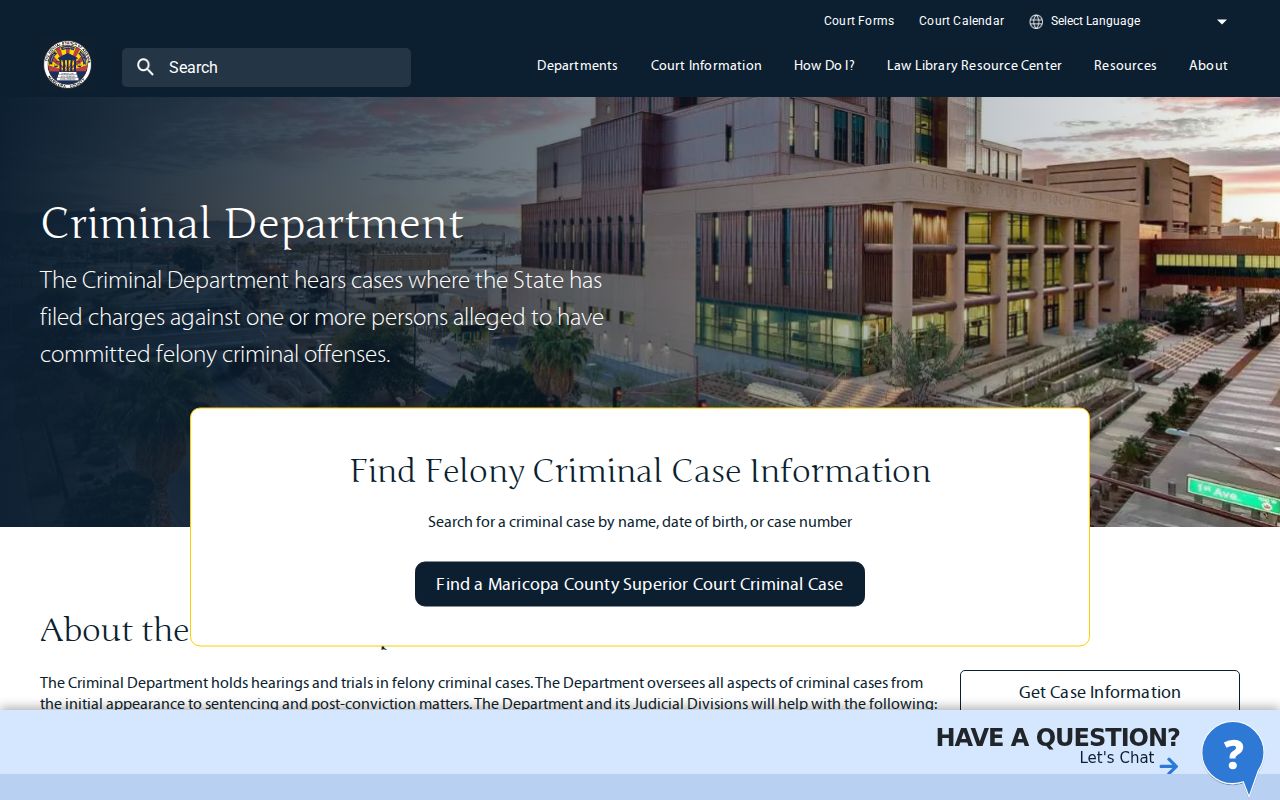
The department page helps distinguish court procedure from the separate public case-information search.
Maricopa County Criminal Minute Entries
A bare docket label may state only that a hearing occurred or that a motion came up. The detail lives in the minute entry. Linked or listed separately, it often carries the ruling. It may also give the next setting, a reassignment, or an order to file something by a deadline. Work through entries in date order. Then look for a later minute entry that changes the result, because a reset never erases the former date from the history.
- Minute entry
- A written judicial record of a ruling, direction, or proceeding.
- Arraignment
- The proceeding where charges are stated and a plea is taken.
- Continuance
- A move to a later setting; the older event remains visible.
- Disposition
- The current outcome of a count or case, such as dismissal or conviction.
When a public image is missing, registered users can turn to Arizona eAccess, which covers eligible Superior Court criminal filings from July 2010 forward. Certified or archived items still come through the Clerk.
Criminal Case Stages on the Docket
A felony docket often starts small. Complaint and initial-appearance activity comes first. A grand-jury event may follow, then an indictment or information and an arraignment. The middle of the record fills with disclosure, motions, responses, and pretrial conferences before the docket tracks a plea or trial, a verdict or other disposition, sentencing, probation events, and a possible appeal. Not every case hits every stage. When charges are changed or dismissed, the sequence can branch.
Docket flow: Filing → Arraignment → Pretrial → Plea or Trial → Disposition → Sentencing
An indictment is an accusation, never a conviction. A plea setting, in the same way, does not prove a plea happened. Read each event beside its later minute entry, then check every count for its own outcome. Sentencing and later probation events are distinct parts of the Maricopa County criminal docket. They are not a single merged result.
Maricopa County Criminal Counts and Outcomes
One case can hold several counts, each with its own outcome. Never stop at the case-level status. Go count by count. Look for guilty or convicted, not guilty or acquitted, dismissed, dismissed without prejudice, plea, no contest, sentence imposed, probation, set aside, sealed, or appealed. "Dismissed without prejudice" can allow later refiling. A set-aside is a later statutory event, and it does not erase the record.
Key distinction: Bond forfeiture concerns release security. It is not a conviction or dismissal of the criminal charge itself.
Minute entries around the charge rows help decode the shorthand. If the public view and a filed document seem to conflict, the original file maintained by the court controls.
Maricopa County Criminal Docket Courts
The Superior Court of Arizona in Maricopa County holds the felony matters. General-jurisdiction criminal cases sit there too. Justice Courts keep their own misdemeanor and traffic records inside county precinct jurisdiction. Municipal Courts handle misdemeanors and city-code violations. Most citations written by city police land there too. No single Maricopa County criminal docket portal covers all three levels at once.
| Court | Criminal docket covers | Where to search |
|---|---|---|
| Superior Court | Felonies and related CR proceedings | Local Docket, calendar, eAccess, or Clerk |
| Justice Courts | Precinct misdemeanors and traffic | Originating Justice Court or statewide discovery |
| Municipal Courts | City misdemeanors, ordinances, and citations | City court portal or clerk |
A lower-court appeal creates new events in Superior Court. The originating court keeps its original file. That is why one case can carry both a city or Justice Court record and a later county appeal record.
Maricopa County Criminal Hearings and Resets
Need a courtroom location fast? The court's Today's Hearings search lists the building, floor, room, time, case number, and hearing mode, and it refreshes often. One gap matters: Initial Appearance calendars never appear there. Those hearings run around the clock on set schedules, so a missing result does not mean no initial appearance exists.
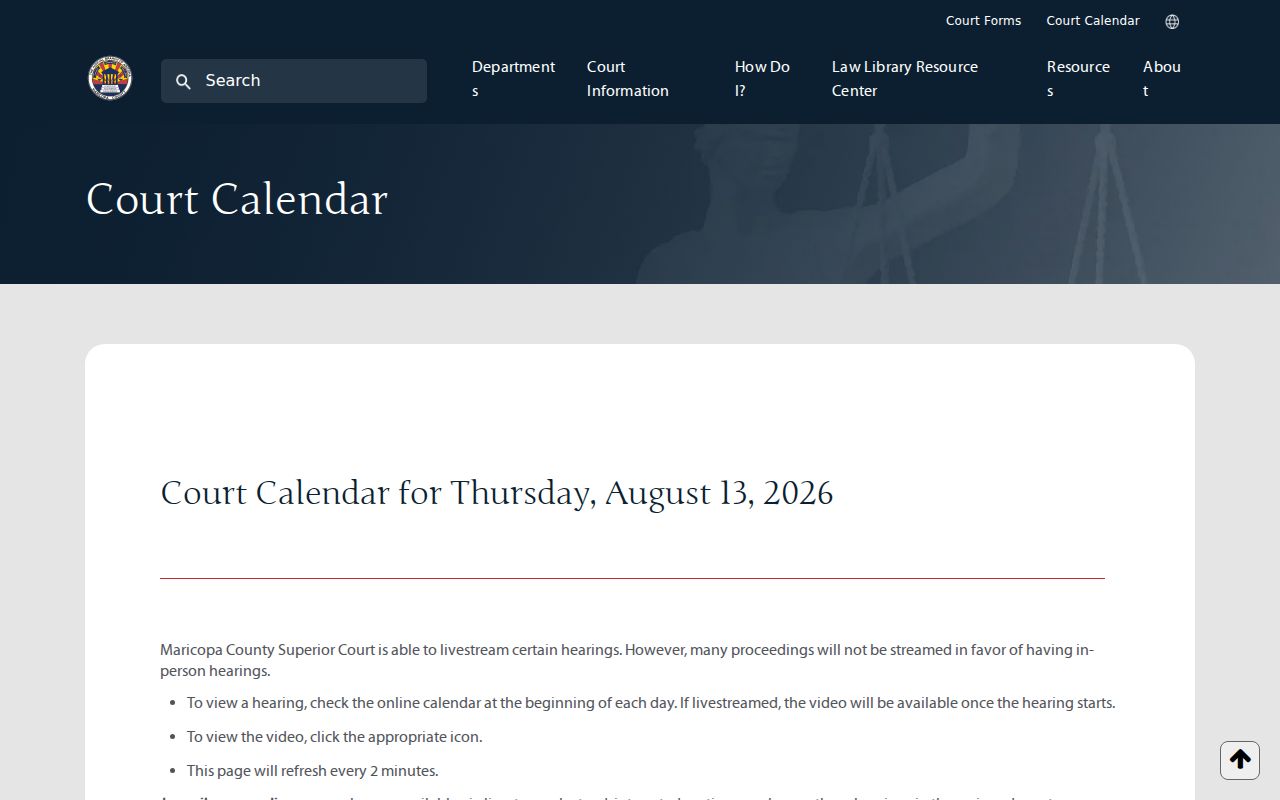
Treat the hearings listing as a confirmation layer. It does not replace the latest minute entry or a call to the division itself.
Hearings move, and the docket shows the history. Read it in order. An old setting stays on the record, and a later entry supplies the reset or notes that the event was vacated. When attendance matters, confirm the newest future date with the assigned criminal division through the Judicial Officer directory.
Missing Maricopa County Criminal Documents
A docket entry is only an index line. The filing itself may sit elsewhere. For civil and criminal Superior Court images filed from July 2010 onward, use eAccess, which requires an account and charges for documents or subscriptions.
Older records, missing images, certified copies, or originals bearing the filing stamp call for other routes. Use a Clerk public terminal or the counter. The Clerk's online records request works too. So does a question about off-site retrieval. The assigned division phone can also answer a setting question. Justice or Municipal Court files come from that court's own clerk.
Statewide Public Access is a discovery tool, not the custodian. It updates weekly and excludes sealed matters, protection orders, victim and witness data, juvenile delinquency, and local-ordinance charges. The Maricopa County docket search path can help you pin down the right case number before requesting a document.
Access Rules for Criminal Dockets
Judicial rules govern most access to Arizona court records. Anyone may inspect open docket information at the courthouse. No noncommercial reason is needed. Remote access can be narrower than what you see in person. Under Administrative Order 2016-58, a generic register entry can stay visible even when the underlying document is restricted. Sealed is not destroyed. Authorized access still depends on the governing law and any court order.
Key Rules:
Arizona Supreme Court Rule 123 sets public access to judicial records and permits lawful limits for privacy, security, and confidentiality.
ACJA §§ 1-604 and 3-403 govern remote case access and protection of sensitive identifiers.
A.R.S. § 12-119.01 provides the process and effect for sealing eligible criminal case records.
A.R.S. § 8-208 limits access to juvenile court and related agency records.
The official Arizona criminal-record sealing statute sets out the legal rules that limit parts of a Maricopa County criminal docket.
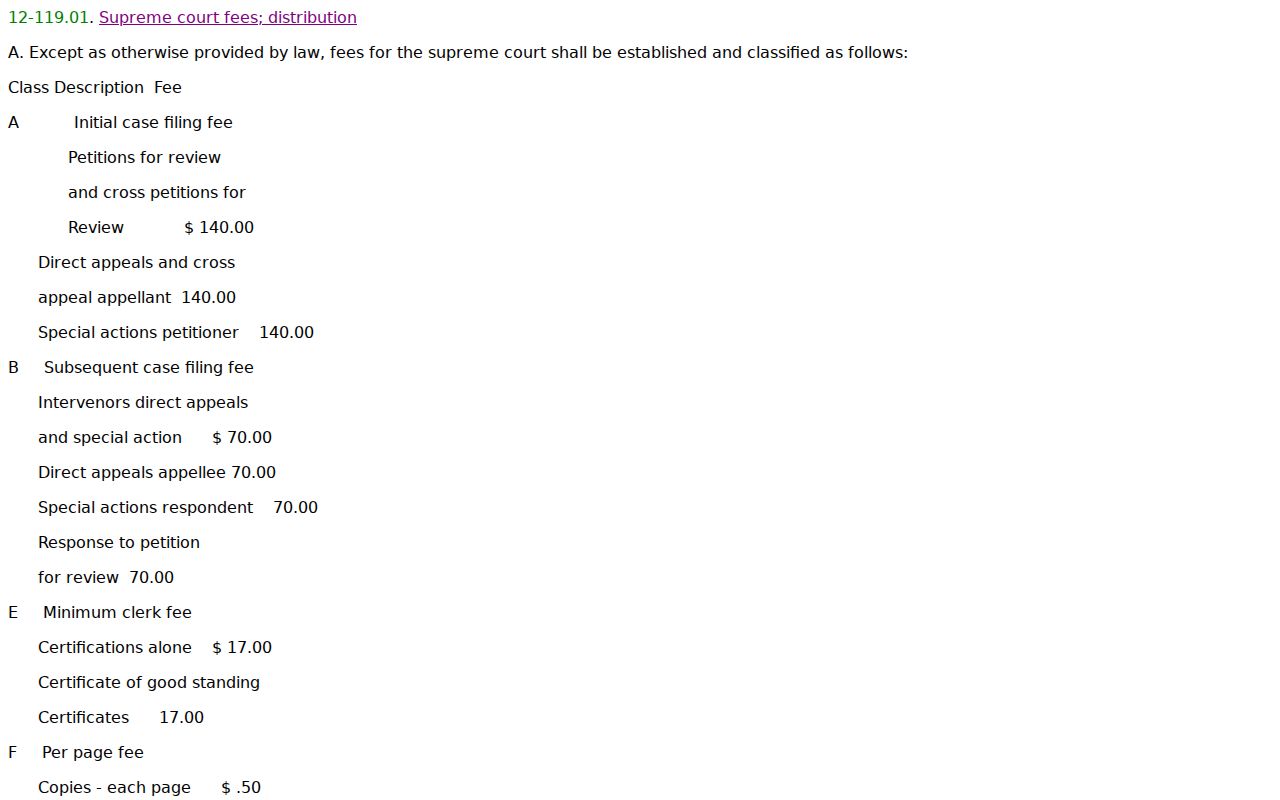
The statute points to one practical takeaway. A search that returns nothing may reflect a lawful access limit, not proof about whether a proceeding ever occurred.
Maricopa Criminal Appeals to Division One
A notice of appeal opens a new layer of the case history. In Superior Court, entries may show record preparation and transmittal. From there the appellate case proceeds under its own number in the Arizona Court of Appeals, Division One. Justice and Municipal Court cases work differently. The first appeal record appears in Superior Court. The originating court keeps the limited-jurisdiction file.
Follow the notice, the appellate number, and any mandates or remand entries. A remand sends work back to the trial court. Fresh criminal docket entries may follow there. Read both records together.